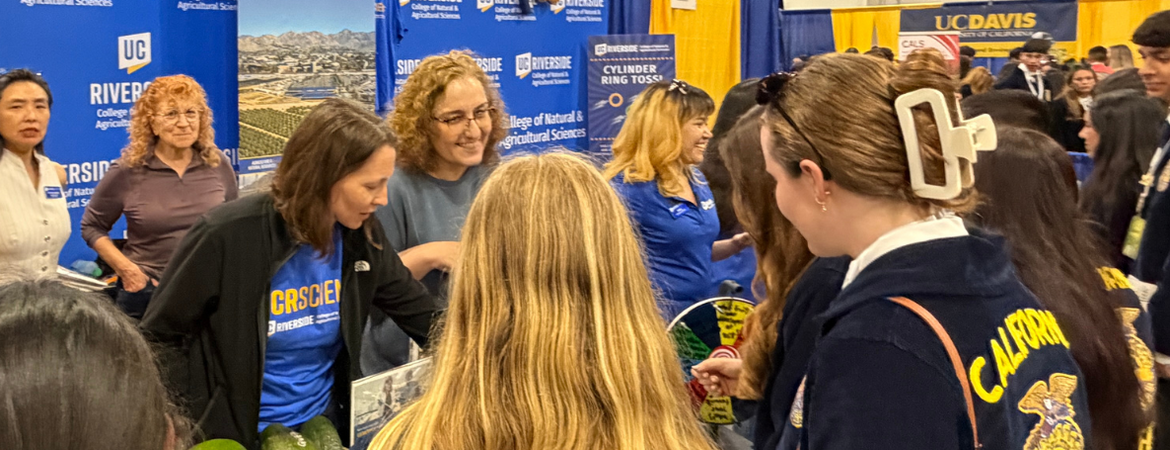
The 98th Annual California FFA State Leadership Conference, held March 21–24, 2026, in Ontario, California, brought together more than 7,000 high school students, advisors, and guests—making it one of the largest statewide events dedicated to developing the next generation of agricultural leaders.
For the College of Natural & Agricultural Sciences (CNAS) at UC Riverside, the three-day conference marked an important milestone: its first time participating—and the beginning of many more to come.
“This is a fantastic recruiting event,” said CNAS Dean Peter Atkinson, who spent time engaging with students and educators throughout the conference. “It really illustrates the level of interest students have in agriculture, sustainability, and the future of food systems. Seeing that enthusiasm gives you a lot of confidence about the future.”
With more than 374 FFA chapters represented from across California, the conference provided a unique opportunity for CNAS to connect directly with students already exploring careers in agriculture, environmental science, and related fields.
Meeting Students Where They Are
For CNAS, being present at the FFA conference was about more than visibility—it was about access.
“As an advisor, it’s important for students to understand all their options,” said Norma Palacios, advising unit supervisor in CNAS. “Sometimes students are only aware of certain schools and don’t realize what other campuses have to offer.”
Throughout the weekend, CNAS representatives answered questions, shared academic pathways, and encouraged students to take an active role in shaping their futures.
“My advice is to ask questions and be proactive,” Palacios said. “Opportunities like this give students exposure to what’s possible—and that can make all the difference.”
Showcasing Pathways in Agriculture and Science
Faculty engagement played a key role in helping students see how their current interests could translate into meaningful careers.
“The FFA is where it all starts,” said Elia Scudiero, Associate Professor of Precision Agriculture. “This is where students get excited about agriculture as a lifelong career. Being here allows us to show them that UC Riverside offers first-class education in plant science, environmental science, and beyond.”
Scudiero also emphasized the importance of building long-term relationships with educators and schools.
“UCR serves as a hub for talent development in our region,” he said. “By connecting with high schools and community colleges, we can create pathways that bring students here, prepare them for impactful careers, and empower them to stay and contribute to the region.”
That vision is further supported by CNAS’s plans to launch a new agricultural science major, offering students a broad, interdisciplinary foundation with opportunities to specialize across areas such as plant production, agribusiness, education, and public policy.
Making Science Personal
At the CNAS booth, learning wasn’t just informational—it was hands-on.
CNAS Science Ambassador Camila Hernandez, an entomology major, brought live Madagascar hissing cockroaches to spark curiosity and conversation.
“I wanted students to get excited about insects and see that they’re part of agriculture,” Hernandez said. “Many of the students here didn’t even realize entomology could be a career.”
For many students, the experience pushed them outside their comfort zones—in the best way.
“They would peek over, unsure at first,” Hernandez said. “But once they came over and interacted, they got excited. It became a moment where they realized, ‘I can do this.’”
Through conversations like these, Hernandez helped students connect their FFA experiences—working with crops, soil, and livestock—to broader scientific and career possibilities.
Planting Seeds for the Future
CNAS’s presence at the FFA conference reflects a growing commitment to building stronger connections with students, educators, and communities across California’s agricultural network.
“It shows that we are a player in this space,” Atkinson said. “People now see UC Riverside as a destination for this kind of education.”
For students like Angel Zarobinski, a fourth-year plant biology major, that visibility matters. A transfer student from Riverside City College balancing school and family, Zaborinski spent three days at the CNAS booth connecting with FFA students and sharing her own journey.
“One of the biggest things is to listen to students—what they’re curious about, what they’re already thinking about—and use that to draw them in,” she said. “You don’t always know where that curiosity will lead.”
Zaborinski found that many students were already interested in agricultural careers but weren’t aware of the full range of pathways available to them.
“They would say they want to go into ag business or ag teaching, and I was able to tell them—we have pathways for that, and even more coming,” she said, referencing CNAS’s upcoming agricultural science major.
She also emphasized the importance of visibility and connection.
“We had people come up and say, ‘It’s about time you’re here,’” Zarobinski said. “Riverside County is a huge agricultural region, and if students know early on that UCR has these opportunities, they can see themselves here.”
As CNAS continues to expand its visibility and outreach, events like the California FFA Leadership Conference represent more than a single moment—they are part of a larger effort to create meaningful, people-centered pathways into science, agriculture, and sustainability.
And for many of the students who stopped by the CNAS booth, that pathway may have just begun.
###
Let us help you with your search