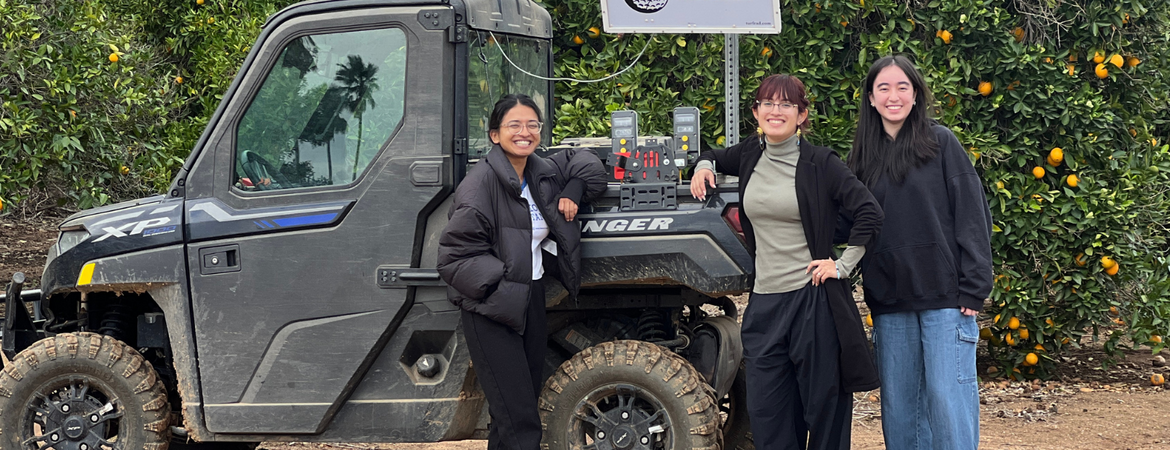
Three students in Professor Elia Scudiero’s Digital Agronomy Lab at UC Riverside's College of Natural & Agricultural Sciences (CNAS) teamed up to win a Best Poster Award at the American Society of Agronomy (ASA) annual meeting held November 9-12 in Salt Lake City, UT. Bhawana Acharya attended the event in Salt Lake City and co-authored the poster with Alexis Castaneda and Melanie Quintana who are both CNAS undergraduate students and Digital Agriculture Fellows in Prof. Scudiero’s Lab.
The poster was titled: Scoping Passive L-Band and IR Radiometry and Active Fluorescence and VIS-NIR Reflectance Portable Sensors for Water Status Monitoring in Citrus and reflects the ongoing work done in Prof. Scudiero’s Lab regarding Precision Agricultural Systems. The research was also co-authored by UCR’s Professor Amir Verdi – who is a co-advisor for Bhawana, and Dr. Jorge Ferreira, a Research Plant Physiologist with the US Department of Agriculture.
Bhawana, a graduate student of CNAS, explained that currently, most growers use a pressure chamber (pressure bomb) to measure stem water potential, which is one of the best ways to know when a tree is stressed and needs irrigation. According to Bhawana, the tool works very well, but it’s slow; 2–3 minutes per leaf and it requires picking leaves, which makes it destructive and labor-heavy, especially in big orchards.
“Our project is trying to make that whole process easier,” she says. “We are testing different ground-based sensors that can be mounted on an ATV and used to estimate stem water potential just by driving through the orchard with no leaf picking required. It’s still early-stage research, and we have a lot to learn, but the goal is to help growers irrigate more precisely and save time. In the future, we also hope to use similar sensors to estimate nutrient status.”
Prof. Scudiero says that the research stands out because it brings truly novel sensing technologies into a form that farmers and practitioners can actually use. “By combining passive L-band and infrared radiometry with active fluorescence and VIS–NIR reflectance measurements, the team is developing a first-of-its-kind integrated approach to support real-time decision making for citrus irrigation.”
He adds: “This kind of sensor fusion goes beyond traditional crop monitoring and gets to what growers really need: accurate, actionable data to guide irrigation decisions. Additionally, it has the potential to improve irrigation practices in citrus crops by giving farmers a reliable, rapid, and high-resolution way to monitor crop stress before it becomes visible. This is a great example of the innovative contributions that UC Riverside’s Center for Agriculture, Food, and the Environment (CAFE) can offer to growers in California and beyond.”
The ASA meeting was actually threefold and included the ASA, Crop Science Society of America, and the Soil Science Society of America. Every year, over 4,000 people from all over the world attend the conference with the ASA’s Precision Agriculture Systems Community sessions among the most popular and competitive when it comes to student competitions.
“The meeting is big and there are so many talented students presenting their work,” Bhawana says. “It really felt like a dream moment.” Twenty-two other students presented in the Scudiero Lab’s poster category.
“I was very surprised and incredibly happy,” when we won, Bhawana says. “Personally, it was my first time winning an award like this, so it definitely boosted my confidence. It made me feel even more motivated to keep improving and pushing my research forward. The Digital Agronomy Lab is a very collaborative, innovative, and supportive environment. Being part of this team has helped shape my research interests and career goals in a meaningful way.”
Alexis has been involved with Prof. Scudiero’s Digital Agronomy Lab since June 2025, when she started the UCR Summer RISE program. At that point in time the workers in the Lab were assessing the potential of different devices (such as a Portable L Band Radiometer, and 3 different active visible and near-infrared sensors) to effectively estimate canopy moisture content. For the last six months, she has been primarily involved with collecting data in the field, cleaning/processing data, and creating visualizations.
“I assisted Bhawana with the data collection and processing of data for her poster,” Alexis says. “During the summer we tested out different sensor positions and angles, ultimately resulting in the finalized angles/vertical positions used to collect the data used for her poster.”
Melanie Qunitana, the other coauthor of the poster, was part of the Digital Agriculture Fellowship (DAF) program during 2024-2025 and began working with active optical sensors and running water content analyses before becoming involved with Bhawana's research on citrus sensing and ground-truthing methods.
“With Bhawana I took part in many of the field surveys we conducted to collect data needed for analyses, including working through multiple 100-degree days,” Melanie says. “I ran the data analyses for the fluorescence active optical sensor as well as ground-truthing data. Bhawana supervised the surveys and led the project overall, supporting Alexis and me in our countless fieldwork endeavors.”
According to Prof. Scudiero, the award highlights exactly why experiential learning and career development programs like the DAF are so valuable. “By giving undergraduate students the opportunity to work directly with advanced sensing technologies in real field conditions, DAF prepares them to contribute meaningfully to real-world agricultural challenges,” he says. “The contribution of Alexis and Melanie to this work shows how hands-on research experiences accelerate learning, spark innovation, and grow the next generation of scientists.”
For her part, Bhawana certainly echoes those sentiments. “My goal is to become a strong researcher in precision agriculture and to work on tools and technologies that make life easier for growers,” she says. “I want my work to have a real, positive impact in the field and help support more sustainable farming.”
##
Learn more about Elia Scudiero, Associate Professor of Precision Agriculture and Director of Center for Agriculture, Food, and the Environment (CAFE) at cafe.ucr.edu.
Let us help you with your search