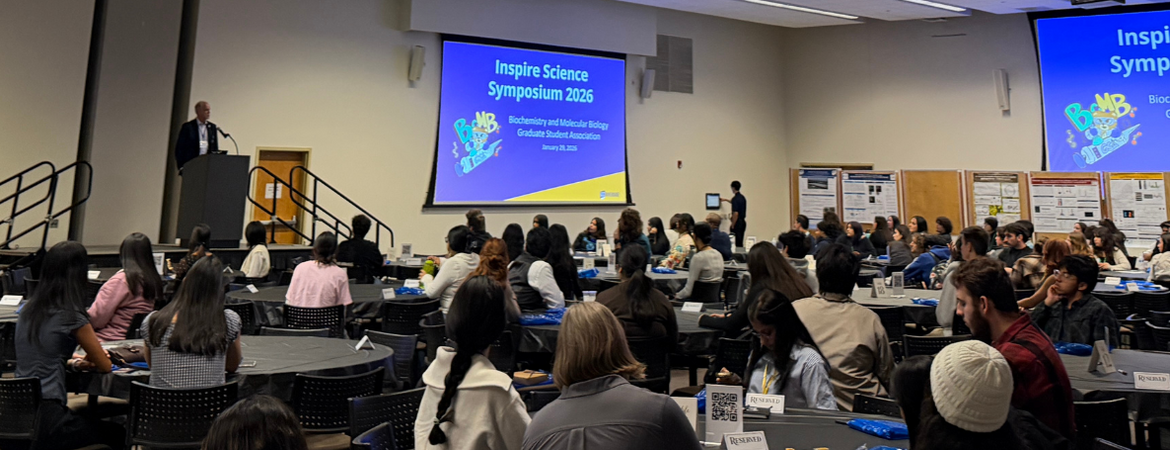
On January 29, 2026, UC Riverside's HUB 302 was filled with an uncommon mix of people: high school students seeing a research campus for the first time, undergraduates imagining what might come next, graduate students reflecting on how far they’ve come, and faculty and campus leaders eager to meet them where they are.
The occasion was Inspire Science, a student-led symposium designed to demystify science careers and expand access to opportunity—and it began with a simple but powerful idea: students belong in science, and they always have.
The event was organized by the Biochemistry and Molecular Biology Graduate Student Association (BcMBGSA), led by Nelli Khudaverdyan, a fifth-year Ph.D. candidate in biochemistry and a proud first-generation scholar. A UCR alum herself, Khudaverdyan founded the BcMBGSA with a clear mission: to create the kinds of opportunities she once needed, but didn’t always see, and to make pathways into science more visible and more human.
“I wanted students to see their future selves,” Khudaverdyan said. “To meet people like them, who started where they started, and to understand that these opportunities are real—and that they belong here.”
Inspire Science marked the first phase of a larger outreach and mentorship initiative. The symposium brought together approximately 50 students and teachers from Ramona High School, more than 200 undergraduate and graduate students, postdoctoral scholars, faculty, and campus leadership from across CNAS and beyond. Throughout the day, speakers shared not just their research, but their stories—moments of uncertainty, nontraditional paths, and the realities of building a life in science.
Opening remarks from CNAS Dean Peter Atkinson set the tone, emphasizing the long arc of discovery and the urgency of the challenges ahead—from sustainability and climate change to human health and agriculture.
“Science matters,” Atkinson told the audience. “You will be the ones who help solve the world’s most serious problems—and you’ll do it together, in collaboration with people who share your curiosity and your commitment.”
The program unfolded intentionally. Faculty and graduate advisors spoke about academic pathways. Graduate students presented research in accessible, non-technical ways. Lunchtime conversations paired faculty with small groups of students, supported by guided questions to encourage dialogue. In the afternoon, high school students moved through a poster session—many encountering a scientific conference for the very first time—asking questions, making connections, and seeing themselves reflected in the people around them.
What made Inspire Science especially notable was not only its scale, but its model. While fully student-conceived and student-coordinated, the event was made possible through strong departmental and CNAS support—from sponsorship and logistics to leadership presence and encouragement. That partnership sent a clear message: meaningful recruitment and outreach can start anywhere, and when good ideas are supported, they can grow quickly and powerfully.
The symposium is only the beginning. In the coming months, participating students will be invited into a structured mentorship program, connecting them with graduate mentors, research labs, and guidance on navigating academic and professional pathways.
For Khudaverdyan, that continuity is essential. “The hardest part was building the foundation,” she said. “Now it’s there. All it takes is passionate students willing to say, ‘Let’s do this.’”
And for everyone who attended, the message was clear: science is not a distant destination. It’s a door—and it’s already open.
###
Let us help you with your search