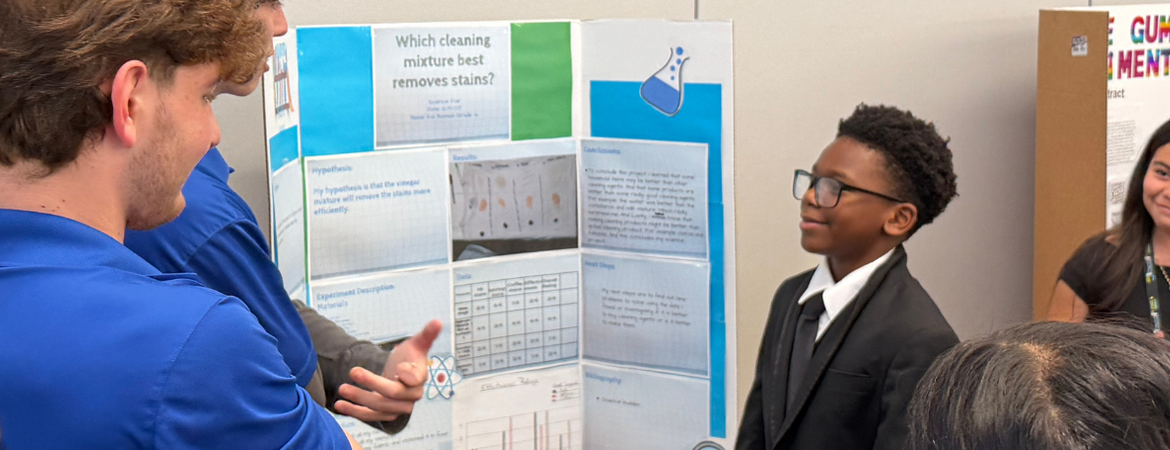
For many Val Verde Unified School District students, stepping onto the UC Riverside campus on Friday, Jan. 23, marked their first time visiting a major research university. By the end of the day, they weren’t just visitors — they were scientists.
Val Verde USD students gathered at UCR for the district’s first-ever science fair hosted by UC Riverside’s College of Natural & Agricultural Sciences (CNAS), presenting projects that explored topics ranging from physics and engineering to environmental science and human health. The event brought together K–12 students, teachers, district leaders, and UCR faculty, researchers, and students in a day centered on curiosity, discovery, and mentorship.
“This wasn’t just about competition,” said Leonesa Sanchez, Val Verde USD Science TOSA and one of the event’s organizers. “It was about giving students the experience of being on a university campus, talking with scientists, and realizing that they belong in spaces like this.”
A Partnership Rooted in Access and Opportunity
Hosting the science fair at UCR was a deliberate choice — one aimed at expanding access to higher education and showing students what’s possible when classroom learning connects to real-world science.
“This event reflects what CNAS values,” said Stephanie Dingwall, CNAS Divisional Dean of Student Academic Affairs. “We want students to see science as something they can participate in, contribute to, and build a future around. Opening our doors to Val Verde students is part of that mission.”
Dingwall emphasized that the science fair represents more than a single-day event. It’s part of CNAS’s broader commitment to community engagement, mentorship, and building pathways into STEM fields for local students.
Scientists at Every Stage Giving Back
One of the defining features of the science fair was the range of judges who volunteered their time — including CNAS faculty, postdoctoral scholars, graduate students, K–12 educators, and CNAS alumni.
CNAS biochemistry faculty member Sarah Radi, who served as a judge, said she was impressed by both the quality of the projects and the confidence students showed in explaining their work.
“You could tell how much thought and care went into these projects,” Radi said. “Students weren’t just presenting results — they understood their process, their challenges, and what they learned.”
Alex De La Vega, a CNAS postdoctoral researcher in the Department of Physics and Astronomy and science fair judge, echoed that sentiment, noting that the fair gave students an authentic glimpse into scientific thinking.
“This is what science looks like,” De La Vega said. “Asking questions, testing ideas, and being open to what the data tells you.”
Val Verde educators Ben Goodwin and Darshak Shah, both of whom served as judges, highlighted the importance of students seeing familiar faces alongside university scientists — especially for those considering futures in STEM. Shah, a CNAS alum, said returning to campus as a judge felt especially meaningful.
“I see myself in these students,” Shah said. “Being here shows them that these pathways are real and attainable.”
Students Finding Their Voice in Science
For students like Andrew Del Villar, Francine Habacon, and Noah Doney, the fair was both exciting and affirming. Presenting their projects on a university campus — and receiving feedback from scientists — helped them see their work in a new light.
“It made me feel like what I was doing really mattered,” one student shared. “I could actually see myself doing this in the future.”
That sense of belonging was reinforced by CNAS Science Ambassadors Saalar Zarnegar and Camilla Hernandez, who spent the day answering questions, guiding students through the space, and sharing their own experiences as UCR undergraduates.
“We want them to know that they belong here,” one ambassador said. “We were in their shoes once.”
Looking Ahead
As the science fair wrapped up, the energy in the room was unmistakable — students lingering by posters, judges offering final words of encouragement, and educators already talking about next year.
For CNAS and Val Verde USD, the day marked the beginning of what both see as a growing partnership rooted in shared values: access, mentorship, and the power of science education to open doors.
“When students can see themselves as scientists,” Sanchez said, “it changes everything.”
###
Let us help you with your search